
Stay informed with the latest company news from Zylox-Tonbridge.
Development and Classification of Peripheral Spring Rings
Table of Content
[Hide]
The peripheral coil, as an important tool for vascular embolization therapy, has evolved over nearly a century from the earliest experimental devices into diversified, precision-oriented, high-performance medical devices. Its application in the treatment of peripheral vascular lesions, such as arteriovenous fistulas, visceral artery aneurysms, arteriovenous malformations, etc., plays an increasingly important role.
The Development History of Peripheral Coils
In 1933, the first coil was born, marking the beginning of vascular embolization technology.
In 1975, Gianturco and colleagues reported on the development of two early embolization devices, initially tested in canine models and subsequently used for clinical renal artery occlusion treatments.
In 1977, Professor Cesare Gianturco first used detachable coils for renal artery aneurysm embolization, pioneering controlled embolization technology. Subsequently, more refined coils were developed to adapt to smaller and more complex vascular environments.
In 1990, Guglielmi invented the GDC (Guglielmi Detachable Coil), a breakthrough that significantly enhanced the precision and safety of embolization treatments in the field of neurointervention. Its successful application further promoted the cross-sector application of this technology to the peripheral vascular system.
In 1996, the Interlock Detachable Coil (IDC) was first described by Reidy and Qureshi as an ideal device suitable for peripheral artery aneurysms and high-flow arteriovenous fistulas in children.
Classification of Peripheral Coils
Modern peripheral coils are diverse in type, intricately designed, and widely applicable to various clinical scenarios. They are classified based on shape, length, material, and release mechanism to meet the treatment needs of various vascular structures and disease characteristics:
By structure and shape
J-shaped spiral
Diamond-shaped
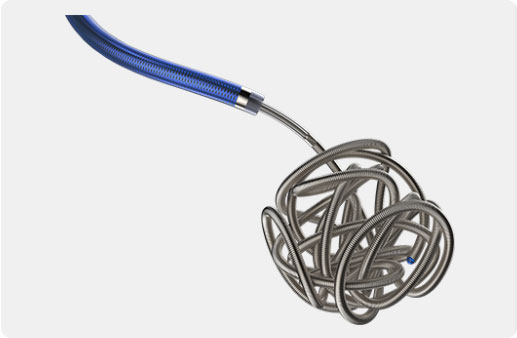
Conical / tornado-shaped
Linear
By size specifications
Length: ranging from 1mm to 600mm
Diameter: from 1mm to 32mm, covering embolization needs from small branch arteries to large visceral arteries
By material composition
Metal materials: platinum, stainless steel
Additional fibers: polyester, nylon, PVA, wool, silk, etc., used to enhance thrombus formation ability
Bare coils: used for rapid closure of specific lesions, with slower thrombus formation speed
By release method
Pusher coils: require a guide wire or push rod for delivery
Detachable coils: connected to a push rod, can be released at the appropriate location, offering more flexible, precise, and safe operation
Clinical Indications for Peripheral Coils
Peripheral coils are widely used in peripheral vascular embolization therapy, with indications including but not limited to:
Arteriovenous malformations (AVM)
Arteriovenous fistulas (AVF)
Visceral artery aneurysms (such as hepatic artery aneurysms, renal artery aneurysms, etc.)
Management of endoleaks after EVAR for abdominal aortic aneurysm
Intraoperative auxiliary embolization: used for intraoperative bleeding control or assisting other interventional treatment methods
The development of peripheral coils not only reflects advancements in interventional radiology and materials science but also represents the continuous pursuit of minimally invasive medical treatments in terms of precision, safety, and speed. From the initial device in 1933 to today's highly controllable, widely adaptable products, peripheral coil technology continues to expand its application boundaries and will play an increasingly critical role in the future treatment of vascular diseases.
Return
References